
BookSpring draws from a wide body of research to keep our programs aligned with best practices, leading theories, and new discoveries in reading, education, psychology, sociology, and neuroscience. We aim to align all our programs and evaluations with this basic model, our Theory of Change:
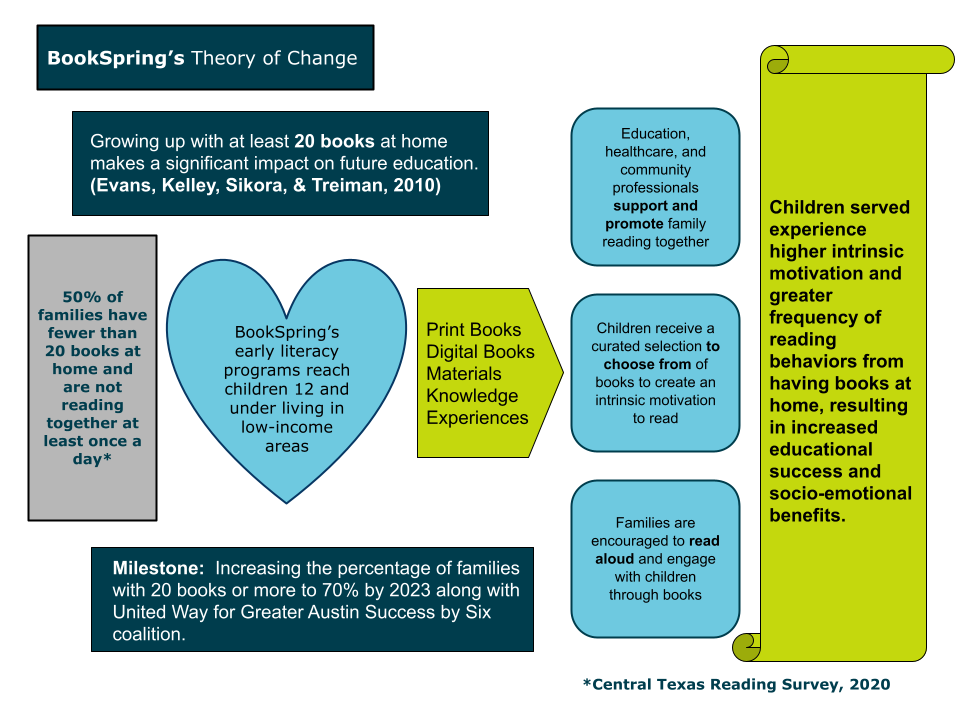
We use measurement scales developed by social science and education researchers to create self-reported surveys for children and caregivers to measure the degree of impact of our desired outcomes. We also leverage skill and achievement scores for evaluation when they are available, but self-reported surveys are appropriate for measuring motivation, interest or love of reading, and empathy and can be applied in a wider variety of settings.
As a baseline for program performance, BookSpring participants should average an aggregated score of 65% or higher across the scale of motivation to read books (adapted from Katranci, 2015) to ensure our program quality is consistent. Our actual average in 2020 was 70%. In addition, 94% of participants agreed it was important to read together twice a day, and 93% would recommend BookSpring to others.